

Some days you don’t want advice, perspective, or a call. You just want the noise in your body to come down enough to think. But if you can’t talk and you can’t settle, the moment stays lodged in you.
Then the secondary spiral starts: you judge yourself for not being over it yet. That judgment adds more activation, which makes clarity even harder to reach.
You try to make meaning before your system is steady enough for meaning.
You can’t process what your nervous system still treats as a threat
The problem itself is simple enough: something hit hard and now you’re stuck in it. What’s harder is feeling alone with a reaction you can’t switch off, especially when everyone tells you to “process it” without ever explaining the sequence.
It comes down to timing. You’re trying to make meaning before your system is steady enough for meaning to land.
Skip stabilization and every thought feels urgent and absolute. That’s not weakness. It’s dysregulation.
Processing isn’t one act — it’s a progression: stabilize, name, then reflect.
◆ Sequence matters more than speed
Skip straight to reflection and you’re just thinking in circles with extra steps.
Follow this private three-step sequence
Stabilize your state before you analyze it.
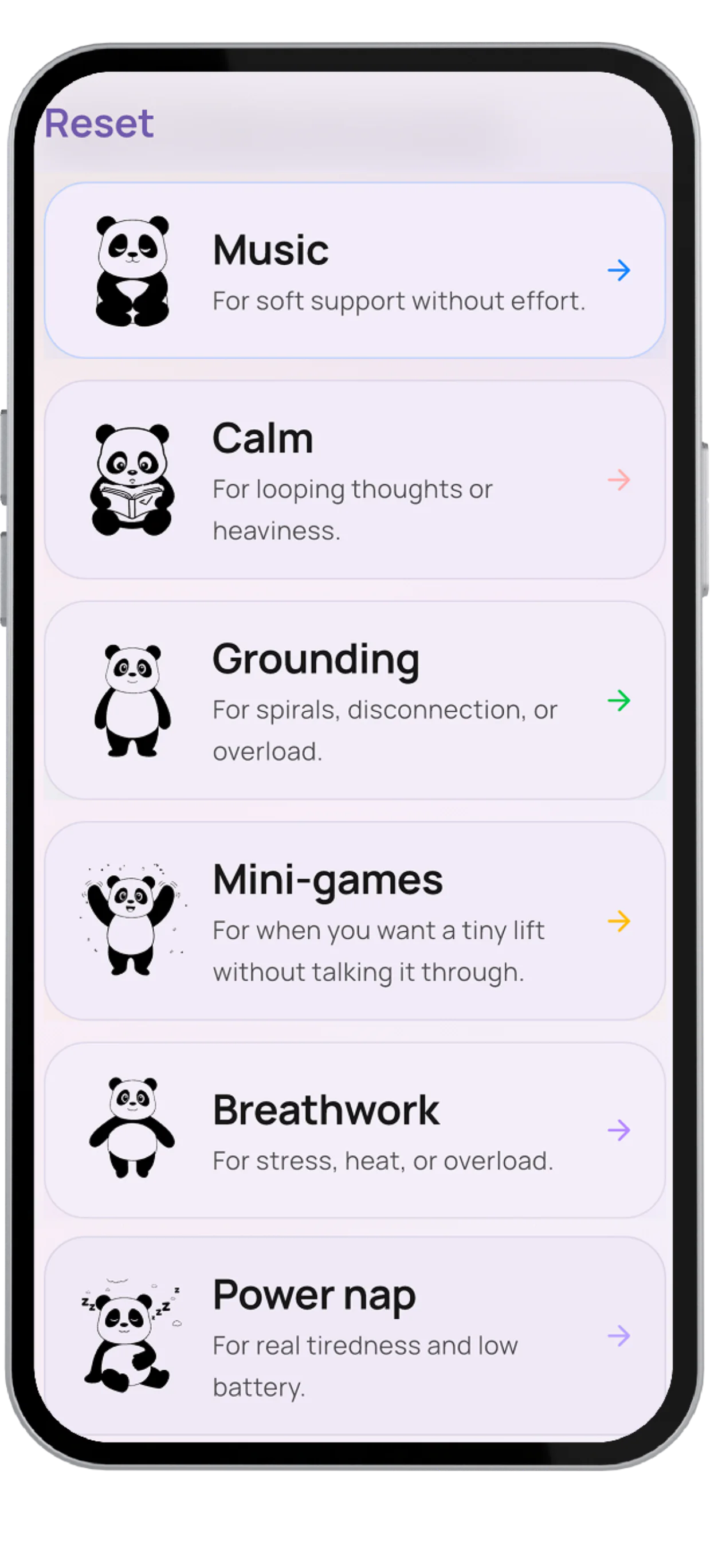
Give yourself 5-10 minutes of regulation first. If you use KeikoAI, open Reset and pick one mode that matches your capacity:
- Breathing when your body is activated
- Calm when your mind is looping
- Music when you need gentle sensory downshift
- Power Nap when everything is depleted
- Grounding for spirals, disconnection, or overload
- Mini-games for when you want a tiny lift without talking it through
Goal: not “feel great.” Goal: from overwhelmed to workable.
A useful benchmark: if your breathing slows and your inner pace drops even 10 percent, you are ready for the next step.
Name what happened in one clear sentence.
When your system drops a little, write one line:
- “What happened is ___.”
Keep it factual, not interpretive. Then write:
- “What I feel is ___.”
If needed, try three emotion words before choosing one.
This interrupts the blur. You move from undifferentiated distress to a defined moment and a defined feeling.
If you can’t find a precise feeling word yet, name direction first: heavier/lighter, tighter/softer, activated/depleted. Precision can come in layers.
Choose one next container.
Pick only one:
- a short reflection,
- a message draft you may or may not send,
- or a boundary you will hold tomorrow.
If you use Keiko Guide, “Just Stay With Me” helps when you need somewhere to put it without a goal; “Understand This” helps when you’re ready to untangle meaning. You are choosing a container, not forcing resolution.
If the conversation starts looping, pause. Return to stabilization. Processing is iterative, not linear.
The key is dose. Small, specific, repeatable. Over-processing in one sitting can reactivate the same loop.
The moment stops owning your whole day
When you process this way, difficult events still matter, but they stop expanding into your entire identity. You’re no longer “a mess.” You’re a person having a hard moment with a method.
You begin trusting that you can meet yourself even when you’re not ready to be seen by anyone else. That trust takes some of the panic out of the next time something hits.
You also become less likely to send reactive messages you later regret. A short private pause often protects decisions, relationships, and sleep.
And over time, you stop confusing silence with avoidance. You learn the difference between hiding and pacing. One shrinks you. The other helps you come back with your footing.
You stop waiting to feel perfect before you respond to life, and you get one concrete thing in return: a way to move from flooded to grounded, one step at a time, instead of just white-knuckling it.
✦ Section takeaway
Small, specific, repeatable beats forcing resolution too soon.
Process hard moments privately, with structure
Use KeikoAI to stabilize first, name clearly, and choose one next step without forcing a conversation.
Try KeikoAI freePrivate by design · No streak pressure
Follow us to see what's new